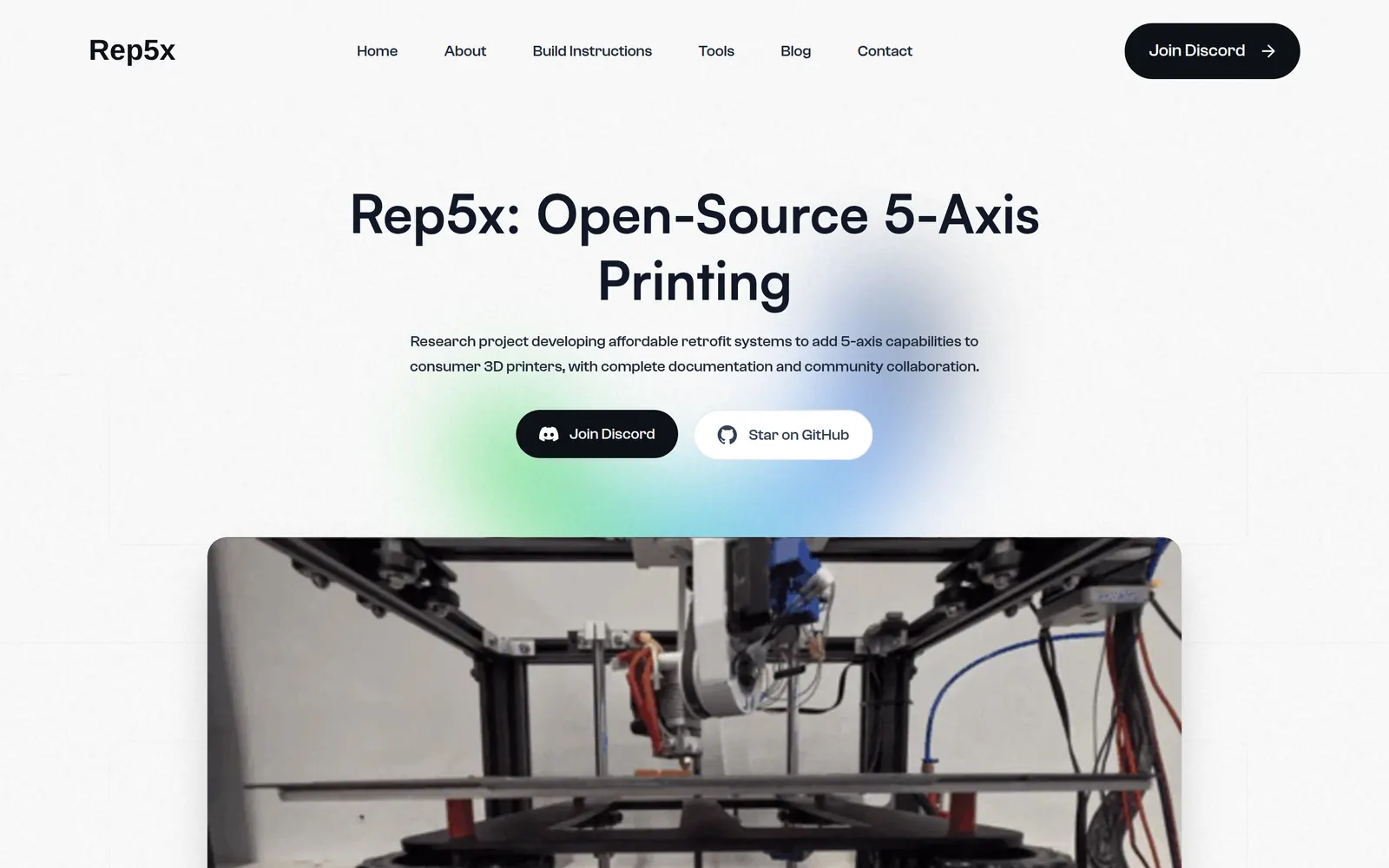
Master's Thesis: Democratising 5-Axis Printing
My master’s thesis at the University of Twente, MSc Industrial Design Engineering (Management of Product Development), supervised by Janis Andersons and completed in 2026.
Democratising 5-axis printing: making an open-source system to bring multi-axis 3D printing to consumer machines.
The Question
Multi-axis 3D printing promises support-free overhangs, smoother curved surfaces, and parts whose layers follow their load paths. Yet it stays confined to research labs and industry.
The technology isn’t the obstacle. Earlier work in the group had already shown that an affordable five-axis retrofit of a consumer FDM printer works. A working prototype existed. Almost nobody reproduced it, because doing so meant commercial software, specialist knowledge, and far more effort than the makers it was meant for could reasonably take on.
So the research question wasn’t whether it could be built. It was why a working prototype isn’t being reproduced, and what it takes to change that.
Approach
Following a Design Science Research methodology, I diagnosed the adoption barriers through Rogers’ diffusion of innovations and the open-source-hardware reproducibility literature, then addressed them directly rather than treating reproduction as someone else’s problem.
Rep5x
The result is Rep5x:
- a five-axis retrofit redesigned to adapt to several common desktop printers, instead of one machine in one lab
- a Marlin fork with native five-axis kinematics
- a suite of browser-based tools that replace the command line and commercial licences with no-install workflows for firmware, setup, printer control and G-code
- the documentation, website and community that let someone actually build it
All of it released under GPL v3.
Evaluation and Finding
I evaluated the system through a pre-build interest survey, community-driven iteration, and independent build attempts by other people.
The finding is that the barrier to multi-axis FDM isn’t the mechanism. It’s the toolchain and the infrastructure around it. Removing the specialist-software dependency, packaging the workflow for non-experts, and building a community where feedback drives the design are what turn a working prototype into something independent makers can reproduce.